
OSIRIS-APEX, a follow-on to OSIRIS-REx, will study the physical changes to asteroid Apophis after the asteroid’s rare close encounter with Earth in 2029.
After making history as the first U.S. mission to bring a piece of an asteroid back to Earth, the OSIRIS-REx mission has transitioned to OSIRIS-APEX, short for OSIRIS-APophis EXplorer. Following sample delivery, the original mission team split in two. Half of the team remained on OSIRIS-REx to analyze the Bennu sample, while the others transitioned to the OSIRIS-APEX mission.
The spacecraft is now scheduled to rendezvous with a stony asteroid called Apophis, which is thought to be very different from the OSIRIS-REx target Bennu. Scientists hope to further enrich our understanding of the solar system and potentially hazardous asteroids.
OSIRIS-APEX is a mission to study the physical changes to asteroid Apophis that will result from its rare close encounter with Earth in April 2029. That year, Apophis’ orbit will bring it within 20,000 miles (32,000 kilometers) of Earth’s surface — closer to Earth than our highest-altitude satellites. Our planet’s gravitational pull is expected to alter the asteroid’s orbit, change how fast it spins on its axis, and possibly cause quakes or landslides that will alter its surface. OSIRIS-APEX will allow scientists on Earth to observe these changes.
Additionally, the OSIRIS-APEX spacecraft will dip toward the surface of Apophis – a “stony” asteroid made of silicate (or rocky) material and a mixture of metallic nickel and iron – and fire its engines to kick up loose rocks and dust. This maneuver will give scientists a peek at the composition of material just below the asteroid’s surface.
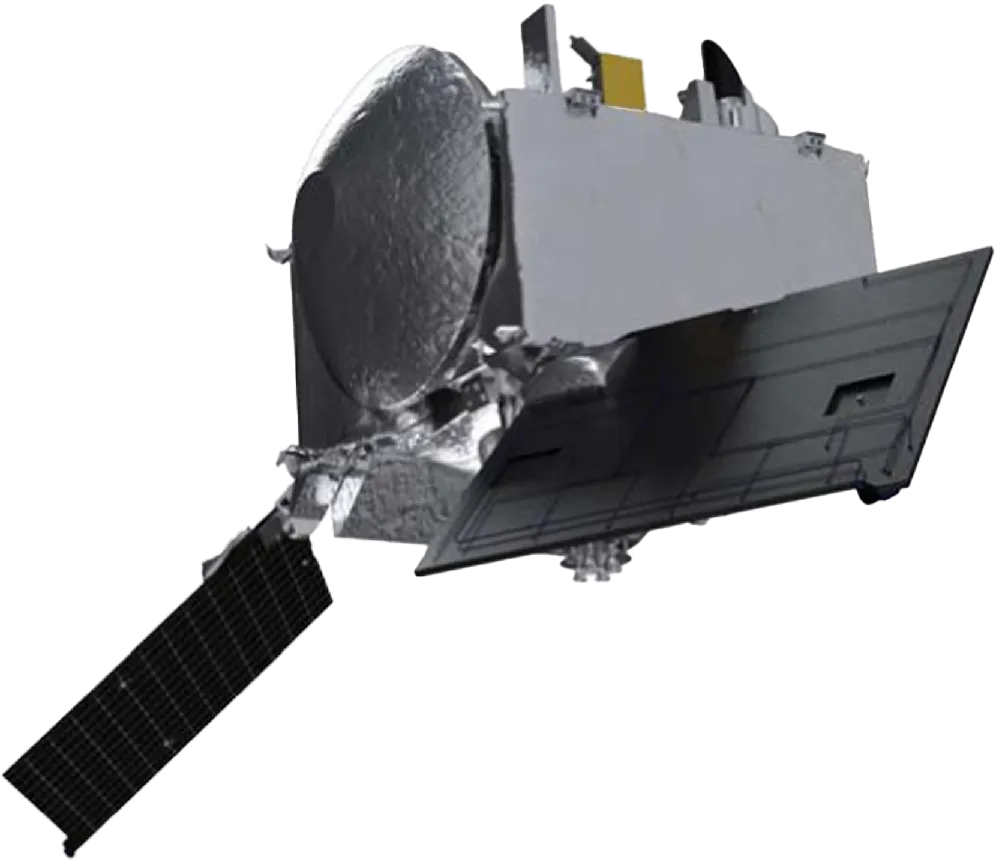
OSIRIS-APEX in its new configuration, viewed from the direction of the Sun. The solar array in the foreground is facing away from the Sun, so the back of the panel is visible. This shades the critical areas of the spacecraft. The solar array in the background is facing the Sun (although not directly) and is being used to generate power.
NASA/Goddard/University of Arizona
.gif)
OSIRIS-APEX, formerly OSIRIS-REx, will use its thrusters to stir up rocks and dust on the surface of Apophis to allow scientists to see just below.
NASA's Goddard Space Flight Center Conceptual Image Lab