
Near-Earth asteroid Apophis is a potentially hazardous asteroid that will safely pass close to Earth on April 13, 2029. It will come about 20,000 miles (32,000 kilometers) from our planet’s surface — closer than the distance of many satellites in geosynchronous orbit (about 22,236 miles, or 36,000 kilometers, in altitude).
Apophis is a relic of the early solar system. It’s made of leftover “raw material” that was never part of a planet or moon. Apophis has a mean diameter of 1,115 feet (340 meters), and a long axis that is at least 1,480 feet (450 meters) long.
When it was discovered in 2004, it appeared Apophis might impact Earth in either 2029, 2036, or 2068. Since then, astronomers have closely watched Apophis using optical telescopes and ground-based radar, allowing its orbit to become better understood. Based on this data, NASA is now confident that there is no risk of Apophis impacting Earth for at least 100 years.
Even though Apophis does not pose any immediate risk to Earth, an asteroid of its size passing so close to our planet is a very rare event. Scientists across the globe are excited to use this opportunity to study Apophis in detail.
Observatories around the world and in space will observe asteroid Apophis’ historic close approach to better understand its physical properties. NASA also organizes the International Asteroid Warning Network (IAWN), which will coordinate Earth-based telescopic observing campaigns before and around the time of the asteroid’s flyby with our planet.
NASA has redirected a spacecraft to rendezvous with Apophis shortly after the asteroid's 2029 Earth close-approach. After successfully completing its mission to gather a sample of asteroid Bennu and bringing it to Earth in September 2023, NASA’s OSIRIS-REx was sent to study Apophis. The spacecraft was renamed OSIRIS – APophis EXplorer (OSIRIS-APEX), and it’s on its way to meet up with its new target.
The European Space Agency, ESA, also is sending a spacecraft to study Apophis. The Rapid Apophis Mission for Space Safety (Ramses), will rendezvous with the asteroid and accompany it through its close flyby of Earth in 2029.
Apophis also will be visible to observers on the ground in the Eastern Hemisphere, weather permitting, without the aid of a spacecraft, telescope or even binoculars.
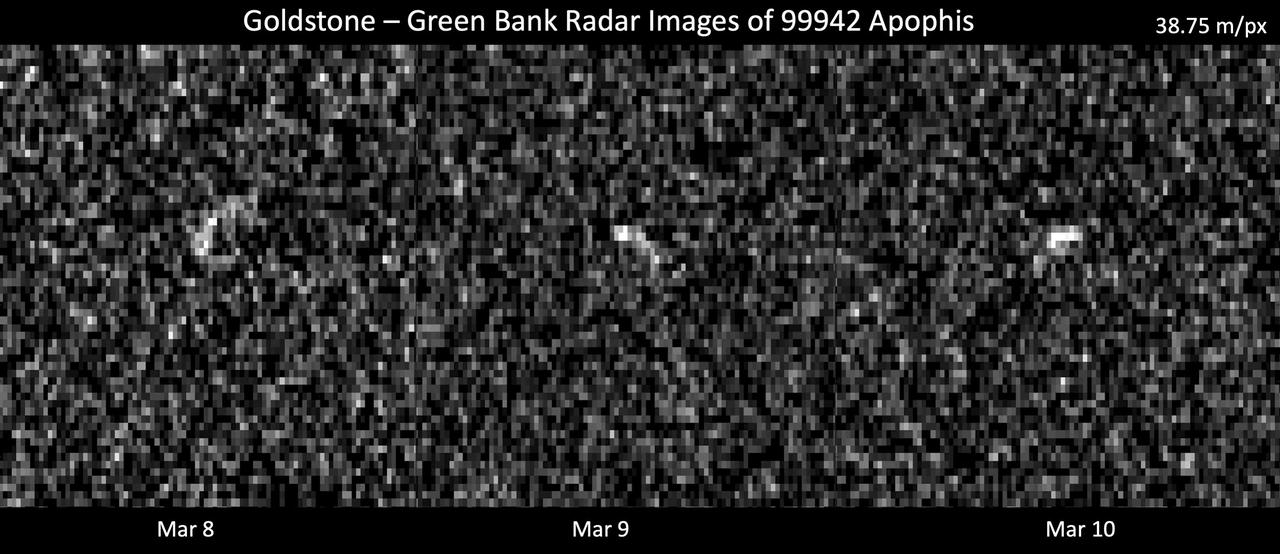
These images represent radar observations of asteroid 99942 Apophis on March 8, 9, and 10, 2021, as it made its last close approach before its 2029 Earth encounter that will see the object pass our planet by less than 20,000 miles (32,000 kilometers). The 70-meter radio antenna at the Deep Space Network's Goldstone Deep Space Communications Complex near Barstow, California, and the 100-meter Green Bank Telescope in West Virginia used radar to precisely track Apophis' motion. At the time of these observations, Apophis was about 10.6 million miles (17 million kilometers) from Earth, and each pixel has a resolution of 127 feet (38.75 meters).
NASA/JPL-Caltech and NSF/AUI/GBO
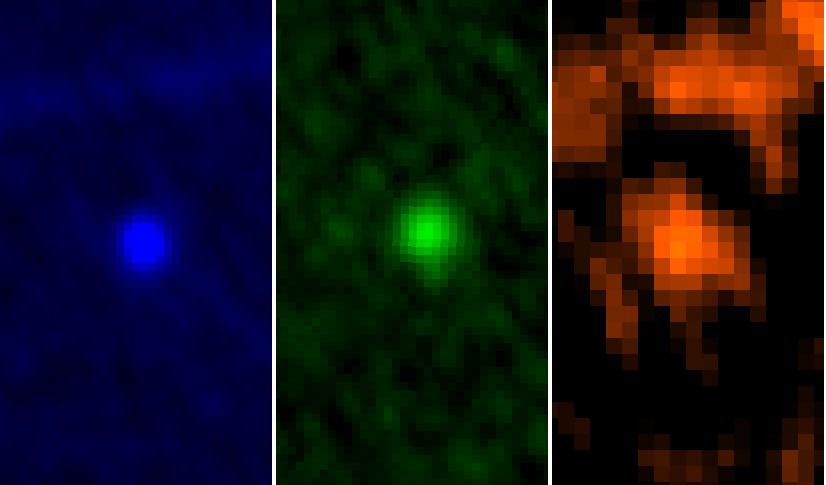
ESA Herschel Space Observatory captured asteroid Apophis in its field of view during the approach to Earth on Jan. 5 and 6, 2013.
Image Credit: ESA/Herschel/PACS/MACH-11/MPE/ESAC